Quick Summary: Under the federal “No Tax on Overtime” provision (enacted under the One Big Beautiful Bill Act for tax years 2025–2028), non-exempt hourly employees can claim a federal income tax deduction for qualifying FLSA overtime pay. Single filers can deduct up to $12,500 and married joint filers up to $25,000. However, the tax break applies strictly to the 0.5x “premium” portion of time-and-a-half pay—not the regular 1.0x base rate. Additionally, overtime remains fully subject to Social Security and Medicare (FICA) taxes, California state income taxes, and income phase-outs starting at $150,000 MAGI.
Navigating FLSA Rules, Deduction Caps, and Form W-2 Box 12 Reporting
The federal “No Tax on Overtime” provision (Section 70202 of the One Big Beautiful Bill Act) created a dedicated federal income tax deduction for qualifying hourly workers.
While marketed as complete tax relief, the law contains specific statutory limitations. To claim the deduction accurately on your Form 1040 without triggering IRS audit red flags, hourly employees and business owners must understand how qualifying compensation is calculated.
Here is a filing guide explaining who qualifies for the overtime deduction, how the math works, and key reporting requirements.
1. The Core Rules: Who Qualifies & How Much You Can Deduct
The federal overtime deduction is a temporary tax measure covering tax years 2025 through 2028.
- Deduction Caps: Eligible single filers can deduct up to $12,500 of qualified overtime compensation from federal taxable income. Married couples filing jointly can deduct up to $25,000.
- Income Phase-Outs: The deduction begins phasing out for taxpayers with Modified Adjusted Gross Income (MAGI) exceeding $150,000 for single filers ($300,000 for joint filers).
- Eligible Workers: Appointed strictly to non-exempt hourly employees working under standard Fair Labor Standards Act (FLSA) guidelines. Salaried exempt professionals do not qualify.
2. The Overtime Math: The “0.5x Premium” Rule
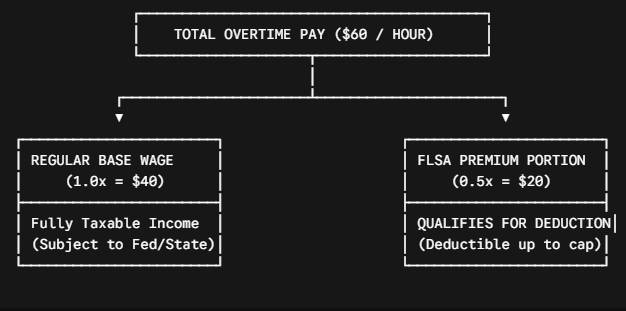
A common point of confusion among hourly workers is assuming that 100% of time-and-a-half pay is tax-free. Under federal rules, only the extra “half” (0.5x premium portion) qualifies for the deduction.
If an hourly worker earns $40/hour regular pay and $60/hour time-and-a-half overtime pay:
- $40/hr (1.0x Base): Remains fully taxable regular wage income.
- $20/hr (0.5x Premium): Qualifies for the federal overtime tax deduction.
3. What the “No Tax on Overtime” Law Does NOT Cover
It is equally important to understand what tax liabilities remain unchanged:
- FICA Taxes Still Apply: Overtime earnings remain 100% subject to Social Security (6.2%) and Medicare (1.45%) payroll taxes.
- California State Income Tax: California does not automatically conform to federal tax changes. Unless California passes state-level conformity legislation, overtime earnings remain fully taxable on California state tax returns (Form 540).
- Paycheck Withholding: Employers continue withholding federal income tax on paychecks throughout the year. You claim the deduction when filing your annual tax return (Form 1040).
4. How Employers Report Qualified Overtime on Form W-2
To claim the deduction on your federal return, the IRS requires proper documentation from your employer:
- W-2 Box 12 Reporting: Employers report your total qualified FLSA overtime compensation in Box 12 using Code TT.
- Employer Recordkeeping: Businesses must maintain clear distinctions between FLSA-mandated overtime (hours worked beyond 40 per week) versus voluntary employer double-time or holiday bonuses, which do not qualify.
Optimize Your Tax Strategy Today
Navigating federal tax law changes requires accurate documentation, proper deduction modeling, and tax return reporting.
At Moontree Tax Service, we assist hourly workers, business owners, and Silicon Valley professionals with W-2 wage adjustments, tax planning, and overall tax preparation.
Schedule a Tax Consultation Today or call us directly at (408) 475-2306.
Disclaimer: This article is intended solely for educational and informational purposes and does not constitute formal legal, accounting, or tax advice. Tax laws change frequently and apply differently based on individual financial profiles and legislative updates.