
Quick Summary: When properly structured as an irrevocable first-party or third-party trust, a Special Needs Trust (SNT) does not count as a countable asset for government assistance programs like SSI or Medicaid/Medi-Cal. Because the beneficiary does not have direct access to or control over the principal, the assets remain protected. However, trustees must follow strict disbursement rules—such as paying vendors directly and avoiding cash payments or unearned support—to prevent accidental reductions in monthly benefits or tax complications.
How Special Needs Trusts Protect SSI, Medi-Cal, and Family Tax Plans
When planning for a loved one with physical or developmental disabilities, preserving eligibility for essential government benefits like Supplemental Security Income (SSI) and Medi-Cal (Medicaid) is a primary objective. Because these programs impose strict individual asset thresholds (traditionally $2,000 for single applicants), a direct inheritance, personal injury settlement, or cash gift can instantly disqualify a beneficiary from receiving care.
This leads families to a crucial question: Does a Special Needs Trust (SNT) count as a countable asset?
When properly drafted and administered, a Special Needs Trust is NOT considered a countable asset by the Social Security Administration (SSA) or California Medi-Cal. However, the specific type of trust, how distributions are made, and how tax returns (Form 1041) are filed determine whether benefits remain protected.
Here is a guide on how SNTs work, the rules governing distributions, and how to structure your estate tax strategy safely.
1. Why a Properly Drafted SNT Is Not a Countable Asset
Under federal law (42 U.S.C. § 1396p(d)(4)) and Social Security guidelines, assets held within an irrevocable Special Needs Trust are excluded from the beneficiary’s personal resource limits.
Because the beneficiary does not own or control the trust assets—and the designated trustee holds absolute discretion over disbursements—the SSA does not treat the trust balance as an available financial resource.
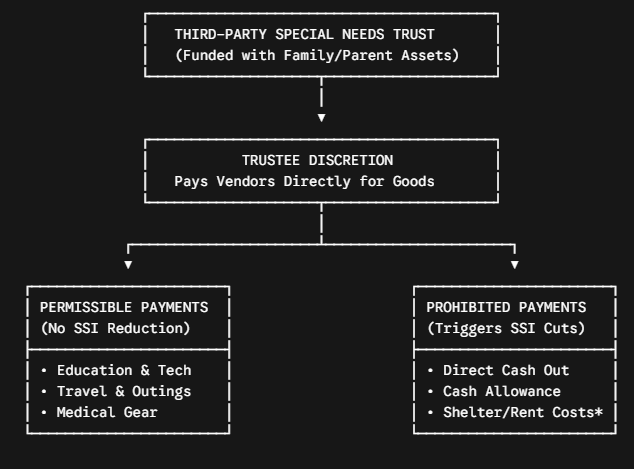
Note: Under updated SSA regulations, direct food payments no longer reduce SSI, but direct housing payments can still trigger In-Kind Support and Maintenance (ISM) rules.
2. First-Party vs. Third-Party Special Needs Trusts
Understanding the origin of the trust funds determines how the trust is taxed and what happens upon the beneficiary’s passing:
| Trust Feature | First-Party (d4A) SNT | Third-Party SNT |
| Source of Funds | Beneficiary’s own money (inheritance, personal injury settlement, direct savings). | Money belonging to parents, grandparents, or family members. |
| Countable Asset Status | Excluded if beneficiary is under age 65 when created/funded. | Excluded with no age restrictions. |
| Medicaid Payback | Required: State Medi-Cal gets reimbursed from remaining funds upon death. | None: Remaining assets pass directly to other family heirs. |
| Tax Status | Taxed as a Grantor Trust (reported on beneficiary’s Form 1040). | Taxed as a Complex/Non-Grantor Trust (Form 1041) or Grantor Trust depending on drafting. |
3. Distribution Rules: How to Avoid Accidentally Triggering SSI Cuts
While the trust principal is not a countable asset, how money leaves the trust can impact monthly SSI benefits:
- Direct Cash Payments (Never Allowed): Giving cash directly to the beneficiary counts as unearned income, dollar-for-dollar reducing their SSI payment.
- Third-Party Payments for Goods/Services (Safe): When the trustee pays third-party vendors directly for items like electronics, travel, education, specialized medical equipment, or vehicles, it is not counted as income.
- Housing & Rent (In-Kind Support): Having the trust pay directly for rent or mortgage costs can trigger an In-Kind Support and Maintenance (ISM) reduction of up to one-third of the maximum SSI benefit.
4. Income Tax & Fiduciary Return Filing (Form 1041)
Special Needs Trusts carry specific fiduciary income tax reporting requirements:
- High Compressed Tax Brackets: Non-grantor trusts reach the top federal income tax bracket (37%) at very low taxable income levels (~$15,000). Proper tax distribution planning (utilizing Distributable Net Income / DNI) prevents trust assets from being over-taxed.
- Qualified Disability Trust (QDT) Status: Certain third-party special needs trusts qualify as Qualified Disability Trusts under Section 642(b)(2)(C) of the Internal Revenue Code, granting them a higher exemption amount equivalent to a personal exemption.
Learn how our San Jose Small Business & Estate Tax Accountant team manages fiduciary tax compliance and trust returns.
Align Your Family Estate & Tax Strategy
Managing a Special Needs Trust requires balancing government benefit eligibility with efficient income and estate tax planning.
At Moontree Tax Service, we work with families, trustees, and estate planning attorneys across Silicon Valley to ensure fiduciary returns (Form 1041), trust distributions, and family wealth transfers are executed seamlessly.
Schedule a Consultation with a San Jose Estate Tax CPA Today or call us directly at (408) 475-2306.
Disclaimer: This article is intended solely for educational and informational purposes and does not constitute formal legal, accounting, or tax advice. Tax laws change frequently and apply differently based on individual financial profiles and trust structures.